top of page

Fibre cement facade without visible fixings
Fibre cement façade panels such as Swisspearl, Equitone, Cedral, and other comparable architectural materials have long been used in ventilated façade systems due to their durability, fire safety, and wide range of finishes. However, traditional fibre cement façade solutions often limit architectural quality — visible fixings, screws or rivets, technically dictated joints, and risks related to panel movement become design compromises. In contemporary architecture, increasing importance is placed on façade visual clarity, precision, and the perception of the material as a solid, continuous surface. It is within this context that SIMPLEX SL RF (Solid Laminum – Rivet Free) fibre cement façade panels have been developed, offering a different approach to the use of these materials.
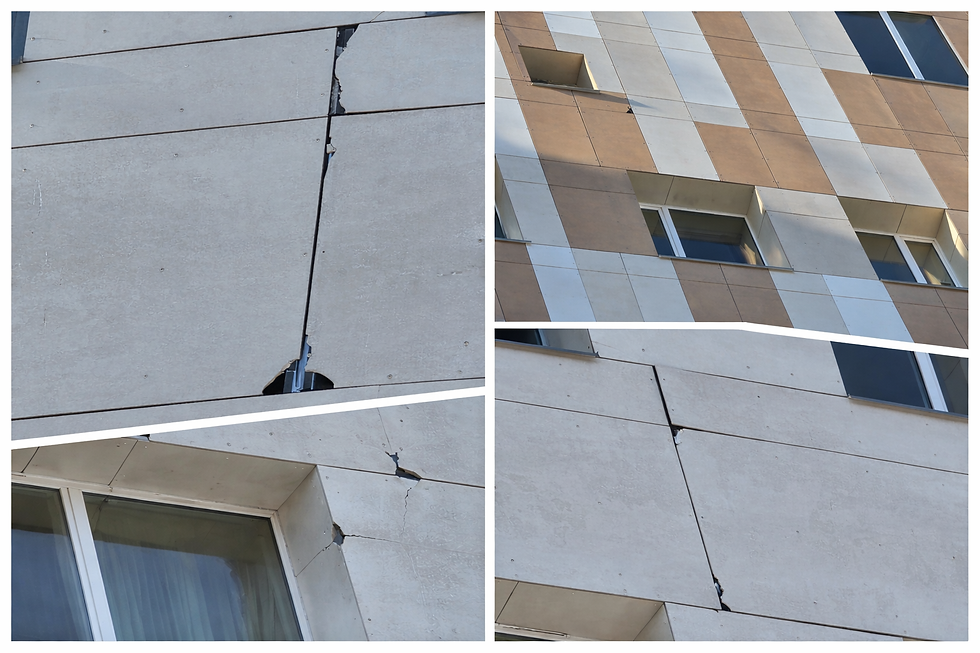
Improper or mechanically restrictive fixings
Damage to fibre cement panels caused by restricting panel movement with rivets
.jpg)
SIMPLEX SL RF with invisible fixings
A concealed substructure system at the rear provides invisible fixings
Architectural Quality and Fixing Logic
SIMPLEX SL RF panels are designed for building walls and ceilings where the architectural objective is to achieve a more solid and high-value perception of the surface by completely concealing fixings and their structural logic. Unlike traditional fibre cement façades — including classic Swisspearl or Equitone solutions with visible rivets or screws — SL RF panels have no visible fixings on the façade plane. Horizontal and vertical panel joints are fully covered with joint cover profiles, allowing the façade surface to be perceived as a unified architectural plane in which the material dominates over technical constraints. Fibre cement panels are fixed using concealed hooks on the rear side of the panel and are hung onto the SIMPLEX substructure during installation. This fixing logic ensures precise panel positioning, secure performance during use, and the ability to remove or replace individual panels if necessary without damaging the façade surface.

Panel Movement, Surface Quality, and Fire Safety
Fibre cement materials are subject to linear expansion due to temperature and humidity changes. In traditional screwed or riveted façades, this often creates surface stresses and increases the risk of deformation. The SIMPLEX SL RF fixing logic provides the necessary freedom of movement for the panels while ensuring that they remain in their original installation position throughout their service life. In several configurations, panels are supported along their entire perimeter, improving surface flatness and overall architectural quality. The SIMPLEX SL RF fixing logic provides the necessary freedom of movement for the panels while ensuring that they remain in their original installation position throughout their service life. In several configurations, panels are supported along their entire perimeter, improving surface flatness and overall architectural quality.

Design Flexibility, Joints, and Durability
Panel dimensions are determined by the selected fibre cement material, while fixing layouts are calculated in accordance with façade structural requirements. In the SL RF approach, panel joints become a deliberate architectural element rather than a technical compromise. Vertical and horizontal joints can be designed from 8 to 25 mm in standard configurations and extended up to 100 mm in expanded configurations, while maintaining safe panel movement.
bottom of page