
Invisible Fixings for Fibre Cement Facade Panels — A Technical Guide
Fibre cement facade panels are one of the most widely specified cladding materials in commercial and residential construction across the Baltics, Scandinavia, and Northern Europe. Brands like Swisspearl, Equitone, and James Hardie are common on project specifications. They are chosen for their durability, weather resistance, low maintenance, and clean architectural finish.
But one question comes up consistently at design and tender stage: how do you fix fibre cement facade panels without visible screws or rivets on the face?

Why Invisible Fixings Matter on Fibre Cement Facades?
Fibre cement panels like Swisspearl, Equitone, and James Hardie are often specified precisely because of their flat, uninterrupted surface. Visible fixings such as face screws, rivets, and bolt heads break that surface continuity and undermine the architectural intent the designer worked to achieve.
Beyond aesthetics, face-fixed fibre cement carries practical risks. Penetrations through the panel face create potential moisture ingress points over the building's lifetime. Visible metal fixings corrode over time, leaving rust staining on the panel surface. Imprecise face drilling at panel edges can also cause cracking or spalling of the fibre cement material.
For these reasons, architects and contractors increasingly specify hidden or invisible fixing systems as standard on fibre cement cladding projects, particularly on commercial buildings, public buildings, and premium residential developments.


The Main Approaches to Hidden Fixings for Fibre Cement
Option 1: Adhesive Bonding
Structural adhesive bonding is conceptually the simplest approach. Panels are bonded directly to the carrier rails without any mechanical penetration of the panel face. No clips, no anchors, no drilling — the adhesive holds the panel and the front face stays completely clean.
In practice this method has serious limitations. Adhesive bonding compromises fire safety performance, as the bond behaviour in fire conditions is unpredictable and most adhesive systems are not approved for use above limited building heights. Regulatory requirements in most European markets restrict adhesive-fixed facades to low-rise applications only. For commercial buildings, public buildings, or anything above a few storeys, adhesive fixing is simply not an option.

Option 2: Swisspearl Sigma 8 Pro and Similar Clip Systems
The Sigma 8 Pro system from Swisspearl is the most well-known approach to invisible fixing for fibre cement panels. Panels are pre-routed on the rear face and a clip profile is inserted into the routed slot. The clip hooks onto a horizontal rail, leaving the front face completely free of fixings.
The principle is sound. The problem is execution. The Sigma 8 Pro system and similar clip-based methods require extremely precise rear routing of each panel, strict dimensional tolerances on every component in the assembly, and a carrier rail system that is perfectly matched to the clip geometry. Any deviation in the routing depth, clip engagement, or rail alignment causes panels to sit unevenly or clips to partially disengage.
On site, achieving and maintaining these tolerances across an entire facade is genuinely difficult. The system demands experienced installers, careful quality control at every stage, and significant time investment per panel. For most projects outside specialist facade contractors, it is technically possible but practically very demanding.

Option 3: SIMPLEX SL RF


SIMPLEX SL RF is a ventilated facade panel system with a patented invisible hook fixings, engineered to achieve a completely clean fibre cement facade surface with no visible fasteners.
The SL RF system uses a precision-engineered hook profile integrated into the rear of the panel. Panels hang via this hook onto the carrier rail with no penetrations, no face fixings, and no visible fasteners on the finished facade. The system is fully compatible with fibre cement panels including Swisspearl, Equitone, and James Hardie boards.
For fibre cement panels specifically, the hook profile is attached to the panel rear using SFS TUF-S micro anchors — a fully mechanical connection with no organic materials involved. This is a critical distinction: because there are no adhesives or organic components in the fixing, the panel assembly retains its fire reaction classification, typically meeting A1 non-combustible rating. This makes SL RF with fibre cement suitable for any building type regardless of height or occupancy class.

The micro anchor system is tested and documented for most widely used fibre cement panel brands and works on panels from 8mm thickness, making it economically viable even on thinner formats. For smaller project volumes, the anchor installation can be carried out directly on site without specialist equipment or climate-controlled conditions — no factory pre-processing required.
Key advantages: completely invisible fixings with a monolithic facade surface, factory-manufactured panels individually verified and registered with a unique digital ID, installation up to 3x faster than traditional face-fixed systems, suitable for both vertical and horizontal panel orientation, and applicable to new build and renovation projects alike.
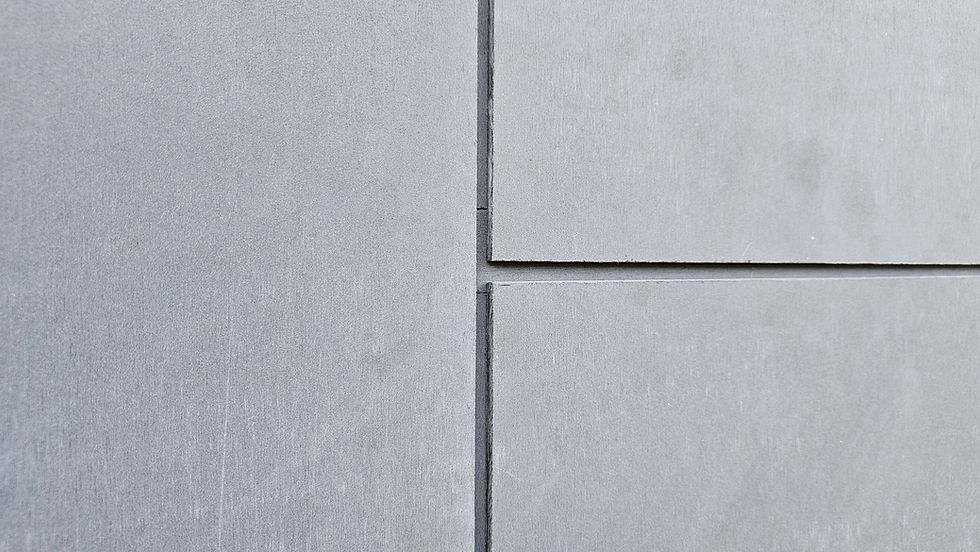
If your project specifies Swisspearl, Equitone, or James Hardie panels and requires an invisible fixing solution, contact SIMPLEX to discuss compatibility for your specific panel format and project requirements.
Summary
There are three approaches to invisible fixings on fibre cement facades. Adhesive bonding is the simplest in theory but compromises fire safety and is restricted to low-rise applications only. Clip systems like the Swisspearl Sigma 8 Pro work on the right principle but demand tolerances that are extremely difficult to achieve consistently on a real project. SIMPLEX SL RF solves both problems — a patented hook-based system that achieves a completely clean facade surface without the fire safety compromises of adhesive or the on-site complexity of clip systems. Panels are factory-manufactured, individually verified, and digitally registered before delivery. Installation is up to 3x faster than traditional face-fixed systems and the system is suitable for both new build and renovation projects.
Looking for an invisible fixing solution for your fibre cement facade panels?
Contact SIMPLEX Technologies to discuss SIMPLEX SL RF for your project.
📧 simplex@simplex.lv 📞 +371 28603704 🌐 simplex.lv/en/simplex-produkti/arhitekturas-paneli/sl-rf


